

A cross-chain swap can appear to be one action while actually being a sequence of dependent events across different blockchains. That is the counterintuitive part: the wallet interface may become simpler precisely as the underlying transaction becomes harder to reason about. A user in the United States might choose a token, select a destination chain, and approve a quote in seconds, yet the route may involve token approvals, a bridge or messaging system, liquidity pools, and a final asset delivery step.
Transaction simulation is an attempt to make that hidden sequence visible before signing. It does not predict the future with certainty, and it cannot turn an unsafe protocol into a safe one. Its value is narrower and more practical: it can show what a proposed transaction appears likely to do under a particular blockchain state. For multi-chain users, that distinction is central. A wallet is not merely a place to store keys; it is also an interpretation layer between human intent and machine-executed contracts.
From signing blind to inspecting intent
In the early period of decentralized finance, many users learned to treat a transaction prompt as a technical formality. The practical question was often, “Is the gas fee acceptable?” That was incomplete. A transaction can consume little gas and still grant a contract broad token approval, transfer an unexpected asset, or interact with a contract whose behavior the user does not understand.
Wallet design has gradually moved toward a different model. Instead of presenting only a destination address and a fee, a modern wallet can attempt to interpret the proposed call: which tokens leave the account, which tokens arrive, what approvals change, and whether the transaction is likely to revert. This resembles a pre-flight check in other complex systems. The check is useful because it catches certain classes of error before execution, but it is not equivalent to a guarantee that the entire system will behave safely.
The mechanism is fairly direct. A wallet or supporting service submits the transaction, or a representation of it, to a node in a simulated environment. The node executes the contract logic against an available view of blockchain state without publishing the result as a finalized transaction. The resulting trace can reveal balance changes, token transfers, approval changes, contract errors, and sometimes warnings about suspicious or unusual behavior.
That explanation also exposes the first boundary condition. The simulation depends on the state supplied by the node and on the accuracy of the interpretation layer. A quote can change after simulation because another trader moves a pool, a block is mined, a bridge route fills differently, or a time-sensitive condition expires. Simulation therefore answers, “What would this likely do against this state?” It does not answer, “What will definitely happen when I sign?”
A practical case: one cross-chain swap, four risk surfaces
Consider a user who holds an asset on an Ethereum-compatible network and wants a stablecoin on another EVM chain. The visible request is simple: swap asset A for stablecoin B. The operational route may be more complicated. The user may first approve a router to spend asset A, then deposit the asset into a bridge or cross-chain service, wait for a message or liquidity action, and finally receive stablecoin B on the destination chain.
Each step creates a different risk surface. The approval concerns authority: how much can a contract spend, and for how long? The swap concerns market execution: what price, fee, and slippage limit apply? The bridge concerns custody and delivery: who controls the intermediate process, and under what conditions is the destination transfer released? The final transaction concerns chain context: is the wallet connected to the intended network, and will the received token be the expected contract rather than a similarly named asset?
A simulation can help separate these questions. Instead of treating the whole route as a single green light, a careful user can inspect whether the first transaction changes an allowance, whether the expected asset leaves the account, and whether the destination-side result is represented clearly. This is a sharper mental model than “the wallet approved my swap.” In many cases, the important question is not whether a transaction succeeds, but what permissions and state changes it creates while succeeding.
Suppose the simulated result shows the expected input leaving and the expected output arriving, with a fee that fits the user’s tolerance. That is useful evidence. If it instead shows no output, an unusually large approval, an unexpected contract interaction, or a likely revert, the user has a reason to pause. A warning is not proof of malicious intent, just as the absence of a warning is not proof of legitimacy. It is an additional signal that should be combined with route reputation, token verification, contract information, and the user’s own understanding of the trade.
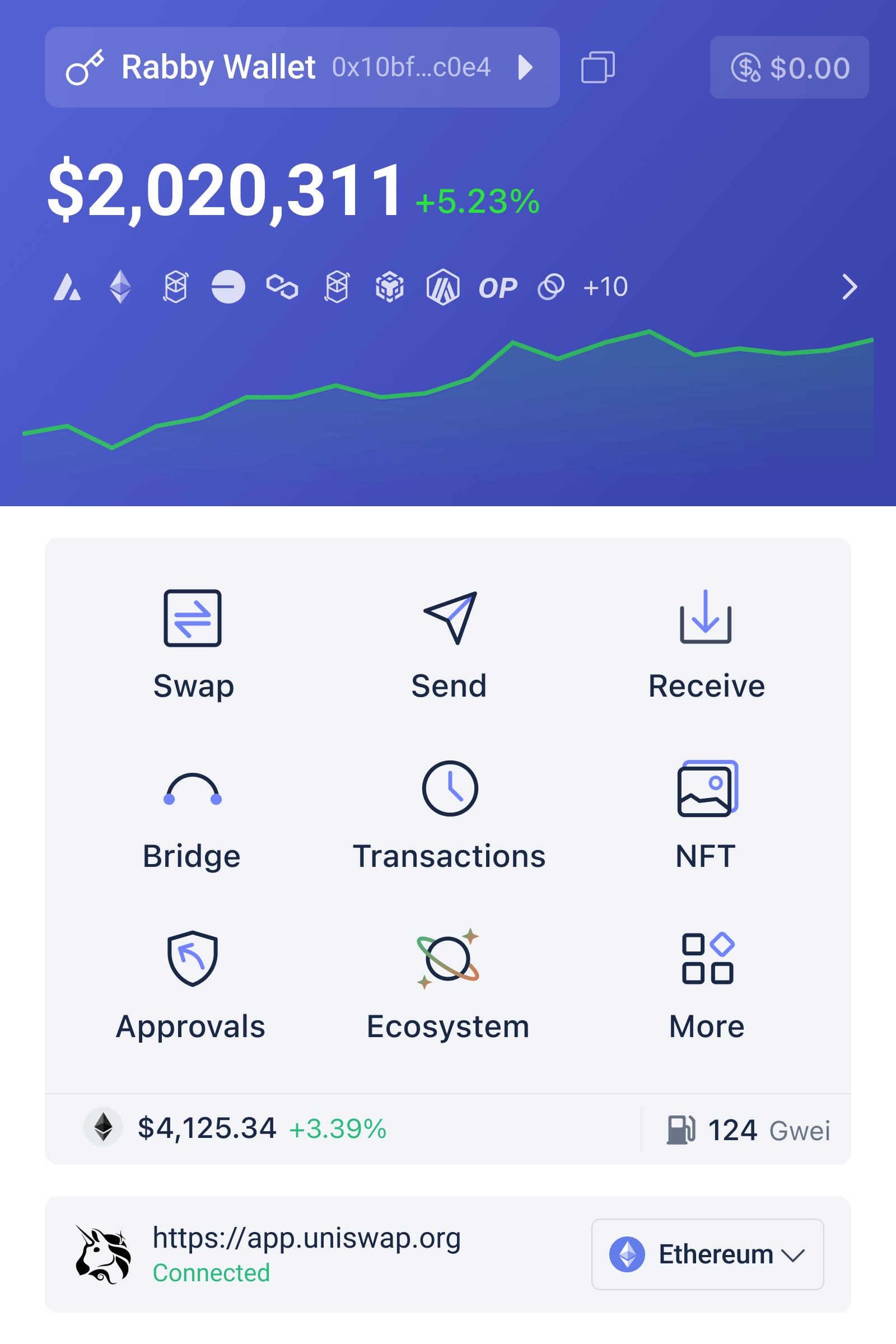
For readers preparing to use a browser wallet, the installation decision should be treated as part of this security process rather than as a cosmetic preference. If Rabby is the wallet being evaluated, users can review the official setup path and rabby extension download information before connecting to decentralized applications. They should verify the browser’s extension details, protect the seed phrase offline, and avoid entering recovery material into websites or pop-ups. A transaction simulator cannot protect keys that have already been disclosed.
Why multi-chain use makes interpretation harder
“Multi-chain wallet” sounds like a storage feature, but it is better understood as a context-management problem. The same ticker can refer to different contracts on different networks. The same decentralized application may expose different deployments, liquidity conditions, or permissions depending on the selected chain. Even the meaning of a successful bridge can vary: receiving a token on the destination chain does not necessarily mean the original asset was settled through the path the user expected.
Cross-chain systems also introduce a separation between execution and observation. A transaction may be finalized on the source chain while the destination action remains pending. During that interval, a user may see a completed deposit but not yet have usable funds on the destination network. A wallet interface that compresses those states into a single progress indicator is convenient, but the user should remember that “submitted,” “confirmed,” “message relayed,” and “asset delivered” are distinct events.
There is another subtle issue: simulation is often local to one chain at a time. A source-chain simulation may accurately show the deposit transaction while saying little about the future destination-chain delivery. The destination outcome can depend on relayers, liquidity providers, bridge rules, message verification, or a separate transaction. For that reason, a cross-chain preview should be read as a set of partial observations, not as a complete formal proof of the route.
Market conditions create a similar limitation. Automated market makers price trades from pool balances, while aggregators choose among available routes. Between the quote, the simulation, and inclusion in a block, the relevant state may change. Slippage protection limits how far execution can move from the expected price; it does not eliminate price impact, liquidity risk, or the possibility that a transaction becomes unprofitable after fees. A technically successful swap can still be economically poor.
How to use simulation without outsourcing judgment
A reusable review framework has three layers. First, check intent: is this the action you meant to initiate, on the correct chain, using the correct asset? Second, check authority: does the transaction create or expand an allowance, and is that allowance necessary for the application’s design? Third, check outcome: which assets are expected to leave and arrive, what fees are charged, and what happens if the route fails or changes?
This framework is more reliable than focusing on a single warning color. It also helps with ordinary transactions, not only dramatic cross-chain transfers. An NFT listing, a lending deposit, a token approval, and a swap all involve different forms of risk. The user should ask what the contract is being permitted to do, not merely whether the transaction is labeled as routine.
Advanced users may reasonably object that simulations can create false confidence. That objection is valid. A malicious contract may behave differently under simulation, a compromised front end may present misleading context, or an external bridge failure may occur after the simulated source transaction succeeds. Node availability and data quality can also affect the preview. These are not reasons to discard simulation; they define its proper role. It is a screening and comprehension tool, not an independent security audit.
For US users, the operational discipline has an additional practical dimension. Cross-chain activity can produce a complicated record of swaps, bridge deposits, fees, and received assets. A preview does not determine tax treatment, and a wallet display is not a substitute for professional advice or complete records. Still, preserving transaction hashes, network information, token contracts, and fee details can make later reconciliation more manageable. Good transaction hygiene serves both security review and recordkeeping.
What may matter next
The recent Rabby project update dated August 24, 2026, positions the wallet around Ethereum and EVM networks and emphasizes broad on-chain use across EVM chains, including access through Chrome and Brave. The meaningful question is not whether a wallet supports many networks in the abstract. It is whether its interface can preserve the distinctions that multi-chain activity creates: chain identity, contract authority, expected asset movement, and the difference between a source confirmation and final delivery.
If wallet tooling improves in that direction, users may spend less time reading raw calldata and more time evaluating comprehensible risk signals. The strongest future systems would not simply produce more warnings. They would explain why a transaction is unusual, identify which assumption the warning depends on, and show where uncertainty remains. That would move transaction simulation from a reassuring label toward a more transparent decision aid.
The signal to watch is therefore not a promise of perfect prediction. It is whether previews become more explicit about their evidence, their time horizon, and their blind spots. For now, the durable lesson is modest but important: before signing a multi-chain swap, inspect the permissions and state changes, verify the network and token contracts, and treat the simulated result as informed evidence rather than certainty.
Frequently asked questions
Does transaction simulation guarantee that a swap is safe?
No. It can reveal likely transfers, approvals, errors, and other effects under a particular view of blockchain state. It cannot guarantee that the route is honest, that market conditions will remain unchanged, or that a separate bridge process will complete as expected.
Why can a cross-chain transaction show as successful while funds are not available yet?
The source-chain transaction may be confirmed before the cross-chain message is processed and the destination-side action is completed. Confirmation, relay, and final asset delivery are separate stages, even when a wallet presents them within one streamlined experience.
What should I inspect before approving a multi-chain swap?
Confirm the selected network, token contract, expected input and output, slippage, fees, and any allowance being granted. Also consider whether the bridge or route introduces an external dependency that the initial simulation cannot fully evaluate.